Exploration as curriculum
Let them be human
Learning through exploration in a truly human way means covering subjects that we consider standard through holistic, real-world projects. This is how we are liberating learners’ insatiable curiosities about the universe we live in and empowering the entrepreneurs and world-builders of the future.
People have a vast range of interests and abilities and the world needs everyone, to be the best they can be, to sustain a good life and enrich our global community.
To create a sustainable existence we need to build healthy relationships with ourselves, others, the things we use and our planet.
Education should be fun and empower all learners to explore a life-long journey of curiosity and exploration.

Whole human exploration areas:

Recognising pattern
Number, Puzzle, symbol, geometry, data, computation
Superior pattern processing (pattern recognition) is one fundamental basis of the unique nature of the human brain, as the basis for intelligence, language, imagination, scientific exploration and invention . Patterns make up the entire universe and therefore seeing and understanding those patterns is the foundation of all learning, development and thriving. By seeing pattern humans can make the world and interactions within that world predictable.
Traditional subject areas often associated: Maths, physics, computing and statistics.
EYFS area: Mathematics

Building relationship
Communication, languages, society, nature, the world
Human brains are wired to relate to the world around them, attaching meaning and context so that we feel connected. We build relationship with other humans, but also with our environment, and find meaning in what we do. Our wiring is so strong in this area that we build deep and meaningful relationships with both people and environment and we need this in order to thrive. This area of the curriculum focuses on understanding and practicing communication with others, and understanding how humans live and operate in the world.
Traditional subject areas often associated: English language, BSL, foreign languages, sociology, nature, geography, ecology, environment.
EYFS area: Communications and language.

Interpreting stories
Literature, Human experience and events, myths, legends, Film, theatre, media
Human beings have been telling stories since before we had the language to tell them (through pictures). We think in stories, remember in stories, and turn just about everything we experience into a story, whether or not every detail is correct and true. We do this instinctively because it keeps us alive and it is our evolutionary advantage. In order to cooperate creatively at a large scale we need to create common goals towards a future communicated. This means telling a story for others. We need to find ways for people to understand what went wrong or right before to avoid or repeat it in the future.
Traditional subject areas often associated: English literature, history, religious studies, media, theatre and film.
EYFS area: Literacy

Seeking truth
Investigation and research, Living things, Matter, Forces and energy
Our brains are wired to understand how and why things happen. We are fundamentally driven to figure out what is going on, to know all about what we experience and to find our truth about the world. Although pattern recognition, relational connections and story creation can lead to bias and even incorrect conclusion, our innate curiosity keeps us exploring novel information to get closer to understanding.
Traditional subject areas often associated: Biology, Physics, Chemistry, Psychology, Philosophy,
EYFS area: Understanding the world

Creating solutions
Enterprise, Technology, Engineering, architecture, Products
In the narrative area of the curriculum students go on RPG (Role Playing Game) adventures into historical settings, such as Ancient China, the Indian Spice trade and Mansa Musa’s Malian empire. They design characters and compose their backstories, considering the beliefs, social structures, professions, etc. of the time they are in. We review the motivations behind the different types of games, learning about strategies, collaboration and game mechanics. All human experience is made of stories and so we can explore everything this way.
Traditional subject areas often associated: Design technology, Crafts, Engineering, Business. Computing and architecture.
EYFS: Physical development

Expressing experience
Visual arts, Performance, production, creative writing, speaking, design
The personal exploration area of the curriculum involves individual passion projects and group projects designed by the students with support from their mentors. We ask learners, what is something that I am curious about; that I want to getter better at; that I’d like to make or that is problematic in my community or the world that I’d like to tackle.
Traditional subject areas often associated: Art, drama, dance, creative writing, interior design, fashion and textiles, games and sports
EYFS area: Expressive arts and design

Developing self
Trauma prevention, Health, Identity, Relationships.Values
The personal exploration area of the curriculum involves individual passion projects and group projects designed by the students with support from their mentors. We ask learners, what is something that I am curious about; that I want to getter better at; that I’d like to make or that is problematic in my community or the world that I’d like to tackle.
Traditional subject areas often associated: Sex and relationships, PSHE, Mental and emotional health, physical education, citizenship and British values.
EYFS area: Personal, social and emotional development
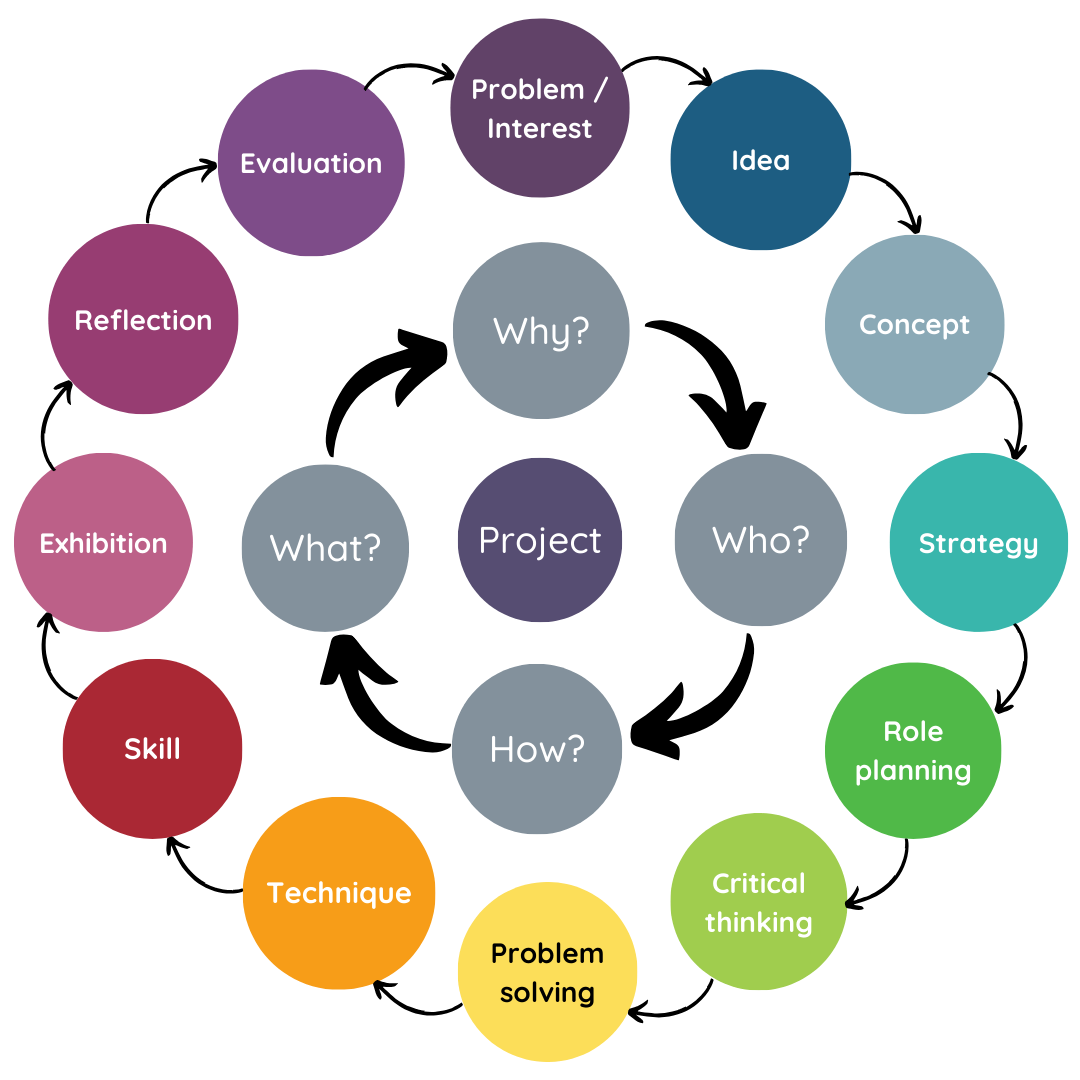
Skills and process
We focus on gaining skills...
Pattern recognition and logic
Noticing and forming patterns within our world is an essential skill. It gives us the opportunity to make connections and use logic.
Movement: Gross and fine motor skills
We must continue to learn to use our bodies in big and small ways, learning new skills and practicing those we already have.
Reasoning and critical thinking
Humans need to learn to draw conclusions from the information with which they are presented, and to do so must examine relationships in order to identify, evaluate and construct arguments.
Self-awareness and management
When humans can understand and manage their own emotions, thoughts, and behaviours, they can recognise their strengths and limitations with a well-grounded sense of confidence and purpose. They will also develop capacity to delay gratification, manage stress, and be motivated and autonomous in accomplishing personal and collective goals
Cooperation and collaboration
Learning two distinct forms of team work, we must be skilled at working with others to achieve shared goals (collaboration), and at working to support others to achieve their own goals (cooperation). At the heart of all this is relationships and social communication.
Creativity, ideation and problem solving
The ability to be creative, to generate useful ideas and to solve problems stems from curiosity, open-mindedness, and courageous imperfection. We nurture those.
...and we go through the process.
We follow a formative assessment model that uses assessment as a tool to support further learning. Students learn to evaluate their progress in discussion with their mentors and to give and receive kind and specific feedback with their peers. Student reports and exhibitions accompany their portfolios to evidence their work, abilities and progress.